India’s Climate Battle Will Be Won In Its Villages, Not In Summits
By Ajay Jain, Chairman, IIM Calcutta Innovation Park
India’s climate response will depend less on global pledges and more on strengthening community-led, locally rooted solutions that help vulnerable regions adapt to a rapidly changing environment
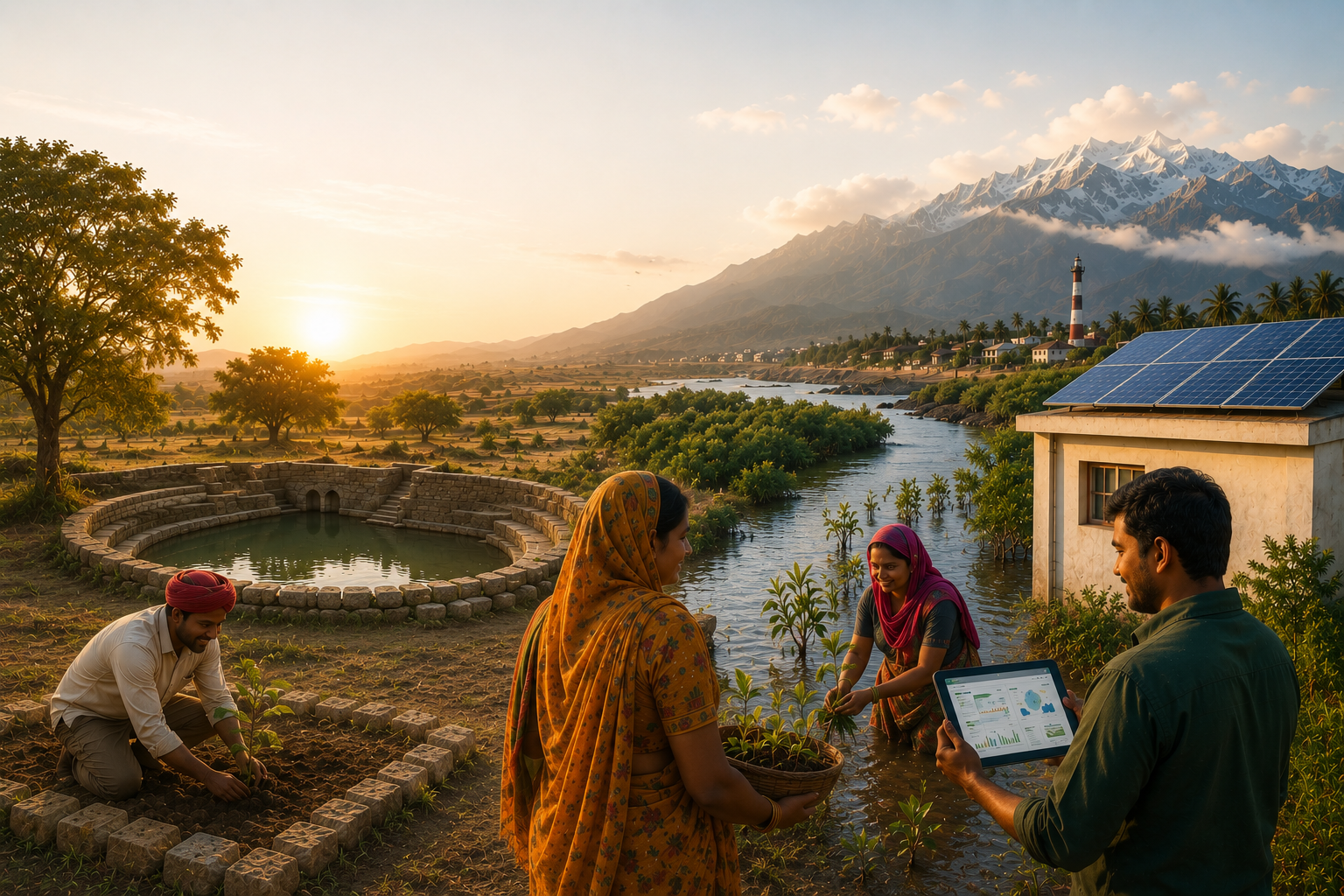
Let me be direct about something: India’s climate battle will not be won in conference halls, policy papers, or billion-dollar summits alone. It will be won in villages rebuilding water bodies, in women-led self-help groups restoring mangroves, in farmers quietly adapting to seasons that no longer behave as they once did, and in small local enterprises solving deeply local problems.
That, I believe, is the most important sustainability lesson India must now embrace. None of this is abstract anymore. In 2024, India recorded its hottest year in history. In November 2023, global temperatures briefly crossed the two-degree warming threshold compared to pre-industrial levels, a line climate scientists had long warned against crossing. Yet, we crossed it.
I think about the Wayanad landslides of 2024 often. They were not a freak event. They were a signal, one of many that keep coming from the Himalayan belt and our coastlines. Climate change is no longer a future scenario we are preparing for. It is already here, and it is moving faster than our policy frameworks are.
The numbers, quite frankly, make for uncomfortable reading. The UN Environment Programme puts the adaptation finance need for developing countries at somewhere between $310 billion and $365 billion every year by 2035. What is actually flowing today? Around $26 billion. No amount of pledging at summits will bridge that kind of gap. And yet, in the middle of all this, something quietly hopeful is taking shape.
Across India’s most climate-vulnerable districts, a different kind of response is emerging. Not from the top, but from within. In Rajasthan, communities are rebuilding johads, traditional earthen check dams that have managed monsoon water for centuries. In Maharashtra, a village called Bela achieved net-zero carbon emissions not through a government scheme, but through collective local action. Along our coasts, women’s self-help groups are restoring mangroves and switching to saltwater-resistant crops, adapting to a rising sea one plot of land at a time.
These are not footnotes to a larger story. They are the story. There is a reason this kind of localised action tends to outlast top-down programmes, and it is really quite simple. Ownership. A solution handed down from outside turns communities into recipients of someone else’s plan. A solution built from within turns them into its guardians. That gap in durability, in how deeply a practice takes root, is not a small thing. It is the difference between a scheme that runs for one budget cycle and a tradition that gets handed down.
India’s growing environment tech sector understands this, at least the best of it does. Platforms like ITC’s MAARS are combining AI-powered crop intelligence with on-ground advisory to reach over two million farmers across eleven states. SolarSquare took rooftop solar and made it modular and affordable enough to power 14,000 homes. These are not replacements for grassroots action. They represent what happens when technology chooses to serve local needs rather than bypass them.
This is where incubators, support organisations, and patient capital come in, though perhaps not in the way they typically see themselves. The job here is not to be the gatekeeper deciding which ideas deserve funding. It is to be an amplifier for what communities are already working out on their own. Find the Johad equivalent for the 21st century. Back it. Help it travel. And, critically, do not try to over-engineer it in the process.
I do not want to minimise what lies ahead. The challenge is immense, the financing gap is very real, and the science gives us little room for comfort. But I have also come to believe that despair is not a strategy. And placing all our hopes in some grand, coordinated global response is a bet that thirty years of climate summitry has not given us much reason to make.
What has actually worked, consistently, looks simpler than we expect it to. Go local. Go deep. Find the solution that the community already understands, and then help it reach further than it could have managed alone. India has always had an instinct for this. It is time to trust it again.